
Archives
About the Archives
The Cathedral Archives contain the recorded history of the Church and the Cathedral of Saint John in the Wilderness.
The archives are themselves part of Saint John’s history, organized in 1968 by Louisa Ward Arps, parish member and local author.
What’s In the Archives
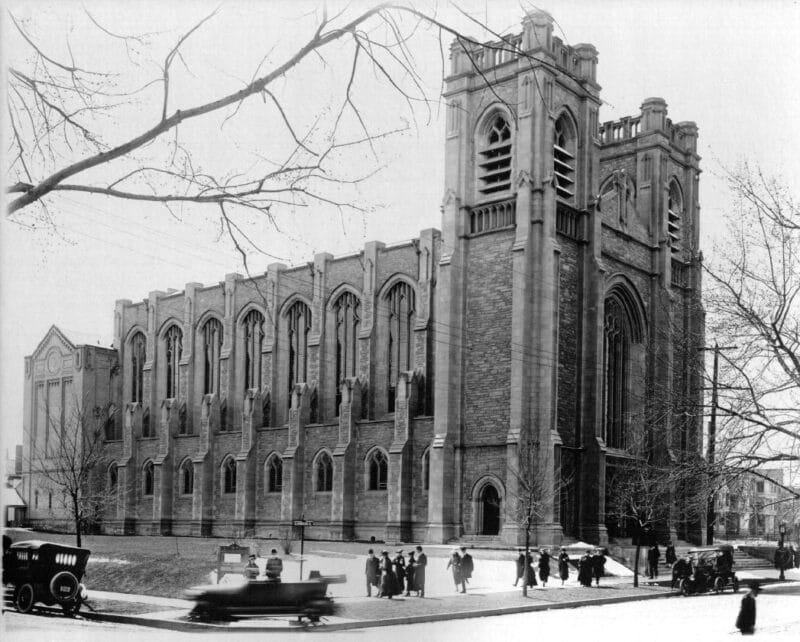
Among the plethora of materials are baptism, confirmation, marriage, burial records, vestry and committee meeting minutes, orders of service, letters and papers, construction plans, a photo collection spanning 160 years, memorial gifts, and our history of social engagement.
The Archive’s Mission
Preserving, curating, and sharing our history make up the mission of Saint John’s Cathedral’s archives. Our dedicated team of volunteer archivists are tasked with preserving our historical records and photographs, adding new records, and working to make our history available to those doing research, as well as to those who have been a part of that history.
Further Reading
Articles from the Arts & Architecture Committee
The Arts & Architecture Committee has released articles on the memorial plaques and other historic memorials in and around the cathedral nave. Click on the links below to read more about some of the characters from our rich history.
-
Charles Kountze (1844-1911)
Charles Kountze arrived in Colorado in 1862 to join his brother Luther in banking. That year, the Church of Saint John’s in the Wilderness acquired a church in Denver and hired Rev. Horace B. Hitchings as its second priest. Kountze became involved with the church, serving as Jr. and Sr. Warden from 1871 to 1877, facilitating its expansion, including the bell tower’s construction. As president of Colorado National Bank, he became a prominent Denver figure. He supported the church’s growth under Dean H. Martyn Hart, aiding in the planning of a new cathedral, which was completed in 1911. Kountze passed away from pneumonia on November 18, 1911, shortly after the cathedral’s first service.
-
Evelyn Albert Denison (1860-1883)
Evelyn Albert Denison was the youngest child of Baron Londesborough and Ursula Bridgeman. After his father’s death in 1860, he quarreled with his stepfather, leading to his departure from England. Evelyn journeyed through Belgium and Philadelphia, eventually reaching Colorado. In Denver, he was taken in by John and Catherine Jones, who cared for him until he mysteriously disappeared in the early 1880s. After a brief return to England for an inheritance, he came back to Denver but succumbed to illness in January 1883. A memorial tablet was later placed in Saint John’s Cathedral, and his funeral was attended by many from the local Welsh community, with his body buried at Riverside Cemetery, marked by a monument from the Jones family.
-
Forbes Rickard, Jr. (1896–1918)
Forbes Rickard Jr. was born in Denver in 1896 and baptized at the original Saint John’s Cathedral. A gifted student, athlete, and poet, he attended Bowdoin College, where he earned several academic honors, including the prestigious Longfellow Fellowship. After graduating in 1917, he chose military service over further studies, becoming a second lieutenant in Company B of the 59th Infantry during World War I. Stationed in France, Forbes frequently wrote home about his experiences, expressing both his faith and dedication to serving his country. On July 19, 1918, at age 22, he was mortally wounded during the Second Battle of the Marne near Château-Thierry. Remembered by fellow soldiers for his bravery and leadership, he was buried at the Aisne-Marne American Cemetery in France. A memorial plaque at Saint John’s Cathedral honors his life and sacrifice.
-
Edward (1858-1926) and Lawrence (1893–1931) Powers
The Powers family’s legacy at Saint John’s Cathedral spans three generations, commemorated through a bronze plaque and stained glass window. The Reverend Horatio Nelson Powers (1826–1890) was an Episcopal priest, poet, and educator who, alongside his wife Clemence Emma Gouraud (1838–1913), supported orphanages and charitable organizations. Their son, Edward Fauvel Powers (1858–1926), helped introduce telephone technology to South America before relocating to Denver in 1899, where he became a successful bond dealer and businessman. Edward’s son, Lawrence Bigelow Powers (1893–1931), attended Yale University and became a prominent investment manager in Denver. He married Ethel May Fewlass in 1929 but died unexpectedly of a stroke just two years later at age 37. A memorial plaque honors Edward and Lawrence, while the nearby stained glass window commemorates Horatio and Clemence, preserving the family’s place in the Cathedral’s history.
-
Leonard Henry Eicholtz (1827–1911)
Leonard Henry Eicholtz was a pioneering civil engineer whose work helped shape the American railroad system and the development of Denver. Born in Lancaster, Pennsylvania, in 1827, he began his career building railroads before serving as a military railroad engineer under General William T. Sherman during the Civil War, eventually achieving the rank of colonel. He later helped construct the transcontinental railroad and witnessed the historic Golden Spike ceremony in 1869. As chief engineer of the Denver Pacific Railroad, he brought the first train into Denver on June 22, 1870. Eicholtz settled in Denver, where he became a successful businessman, bank director, and active member of Saint John’s Cathedral, serving on its vestry. He married Ellen Inslee in 1872, and together they had five children. After his death in 1911, he was buried at Fairmount Cemetery. A bronze plaque at the Cathedral honors both Leonard and Ellen, who died in 1939.
-
Henry Johnson Hersey (1863–1928)
Henry Johnson Hersey was a prominent Denver attorney, judge, and devoted member of Saint John’s Cathedral. Born in Sandwich, Massachusetts in 1863, he was a descendant of early Puritan settlers and earned his law degree from Boston University in 1886. That same year, he married Annie Louise Budlong, a descendant of religious reformer Roger Williams, and the couple moved to Denver. Over his 42-year legal career, Hersey served as Colorado’s Deputy Attorney General, a judge advocate in the Colorado National Guard, and a district court judge beginning in 1918. Beyond his professional accomplishments, he was deeply involved at Saint John’s Cathedral, serving as a chorister, Sunday school teacher, superintendent, vestryman, and warden. Following his death in January 1928, his funeral was held at the Cathedral, where a memorial plaque honors his lifelong dedication to faith, public service, and the Denver community.
-
Frances Thatcher (1842–1928)
Frances Kirtley Thatcher was a devoted philanthropist and longtime member of Saint John’s Cathedral whose generosity helped shape both the Cathedral and the Denver community. Born in Columbia, Missouri, in 1842, she moved to Colorado in 1863, where she married banker Joseph Addison Thatcher. The couple settled in Denver in 1883, and Frances became actively involved in charitable and civic organizations, including St. Luke’s Hospital, the YWCA, and the Denver Women’s Club. A member of Saint John’s Cathedral for more than 40 years, she supported its Women’s Auxiliary and commissioned three stained glass windows honoring her loved ones. Her deep devotion to Holy Communion inspired the establishment of the Frances Thatcher Memorial Fund, which continues her legacy of supporting Cathedral worship. Following her death in January 1928, she was buried alongside her husband at Fairmount Cemetery.
-
William Yardley (1834–1918)
William Yardley was a devoted servant of St. John’s Cathedral, serving as its verger for 29 years. Born in Worcestershire, England, in 1834, he worked as a grocer before immigrating to the United States in 1883 with his wife, Emma Denston, and their ten children. The family eventually settled in Denver, where William became verger of St. John’s Cathedral in 1889 under Dean Martyn Hart. His responsibilities included maintaining the Cathedral, preparing for worship services, and assisting with liturgical ceremonies. He faithfully served through the devastating fire that destroyed the original Cathedral in 1903 and the opening of the new building in 1911. Following his death in February 1918, his funeral was held at St. John’s, and he was buried alongside Emma at Fairmount Cemetery. A memorial plaque in the Cathedral’s west aisle honors his dedication, faithful service, and Christian character.
-
Henry Houseley (1852–1925)
Henry Houseley was a gifted organist, choirmaster, and composer who helped shape Denver’s early musical landscape. Born in Nottinghamshire, England, in 1852, he studied music and gained recognition for his compositions before moving to Denver in 1888 to serve at St. John’s Cathedral. In 1892, he became the Cathedral’s organist and choir director, a position he held until his death. Beyond his work at St. John’s, Houseley taught music at the University of Denver, directed the Denver Choral Society, organized Denver’s first community symphony orchestra, and helped establish the American Guild of Organists. A prolific composer, he wrote operas, cantatas, anthems, and orchestral works. He also helped design the organ for the new Cathedral following the devastating fire of 1903. After his death in March 1925, his ashes were placed behind the Cathedral’s organ pipes, honoring his decades of musical service and devotion.
-
Horace Hitchings (1830–1917)
The Reverend Horace Baldwin Hitchings was an influential Episcopal priest who helped establish and expand St. John’s Cathedral during Denver’s earliest years. A graduate of Trinity College and Berkeley Divinity School, he arrived in Denver in 1862 and served as rector of St. John’s in the Wilderness until 1869. During his ministry, he expanded the growing congregation and traveled throughout Colorado to establish and support new churches. He later served at churches in Maine and New York before returning to Denver, where he became an active property owner and philanthropist. Named Rector Emeritus of St. John’s in 1910, Hitchings remained deeply connected to the Cathedral throughout his life. Following his death in 1917, he left substantial gifts to St. John’s and St. Luke’s Hospital. His legacy is commemorated by the Cathedral’s carved bishop’s chair, known as the cathedra, and his gravesite along All Souls’ Walk.
-
Helen Arndt (1913–1985)
Helen Millett Arndt was a pioneering historic preservationist, civic leader, and devoted member of St. John’s Cathedral. Born in Maricopa, Arizona, in 1913, she grew up in Denver and married Dr. Karl Arndt at the Cathedral in 1933. In 1959, she became the first woman appointed to the Denver Planning Board and later chaired the Denver Landmarks Commission. As a co-founder of Historic Denver in 1970, she helped preserve significant landmarks, including the Molly Brown House and Richthofen Castle. From 1963 until her death, Helen led the Cathedral’s Arts and Architecture Commission, overseeing efforts to protect and restore its historic beauty. Her work helped secure St. John’s designation as a Denver Landmark and its placement on the National Register of Historic Places in 1975. Following her death in December 1985, her ashes were interred at All Souls’ Walk, where a bronze sculpture honors her legacy.
-
Earl James Sinnamon (1919–1980)
Earl James Sinnamon was a respected arborist, horticulturist, and devoted member of St. John’s Cathedral whose work helped beautify Denver’s landscape. Born in Manchester, Connecticut, in 1919, he graduated from Colorado State University before becoming a supervisor of Denver’s city park nurseries and later City Forester. In 1950, he joined Swingle Tree Surgeons, eventually becoming its owner and president. Throughout his career, Earl dedicated his expertise and volunteer efforts to preserving and caring for Denver’s trees, including those surrounding St. John’s Cathedral and the Denver Botanic Gardens. His contributions earned him the Tree Care Industry Association’s prestigious Award of Merit in 1981. Following his death in July 1980, his ashes were interred at All Souls’ Walk. A memorial bench on the Cathedral grounds honors his love of God, nature, and lifelong commitment to making Denver a greener, more beautiful city.
-
The Cornforth Family
The Cornforth family played an important role in the early history and development of St. John’s Cathedral in Denver. Born in England in 1837, Birks Cornforth settled in Denver in 1860 and established a successful grocery business. In 1862, he married Caroline Cooper, and together they became devoted members of St. John’s in the Wilderness. Birks served on the vestry for eleven years and provided financial support that helped encourage Dean Martyn Hart to lead the growing congregation. Their children continued the family’s tradition of service, with daughters Carrie and Bertie participating in the Ladies Aid Society and son-in-law George Knifton serving on the vestry. In 1914, Caroline and Bertie donated elaborate Gothic carvings to complete the Cathedral’s reredos behind the altar. Additional stained glass windows honor Birks, Caroline, Carrie, and George, preserving the family’s lasting legacy of faith, generosity, and service.
-
Mysteries in the Chancel
The chancel of St. John’s Cathedral holds several remarkable works of art and architecture, along with historical mysteries that remain unsolved. One involves a small wooden crucifix originally installed above the altar as part of the Cathedral’s elaborately carved reredos. The crucifix disappeared for decades before being rediscovered, although conflicting accounts leave its whereabouts uncertain. Another mystery surrounds the Last Supper carving on the high altar, created by Peter Rendl in 1910. While Dean Martyn Hart attributed its design to an artist named Giebert, the original artist’s identity remains unknown. A third mystery concerns the Cathedral’s ornate bishop’s chair, or cathedra, donated in memory of the Reverend Horace B. Hitchings in 1918. Its carvings depict three religious leaders, including Bishop Franklin Spalding, whose connection to Hitchings remains unclear. Together, these mysteries offer a fascinating glimpse into the Cathedral’s artistic and architectural history.